
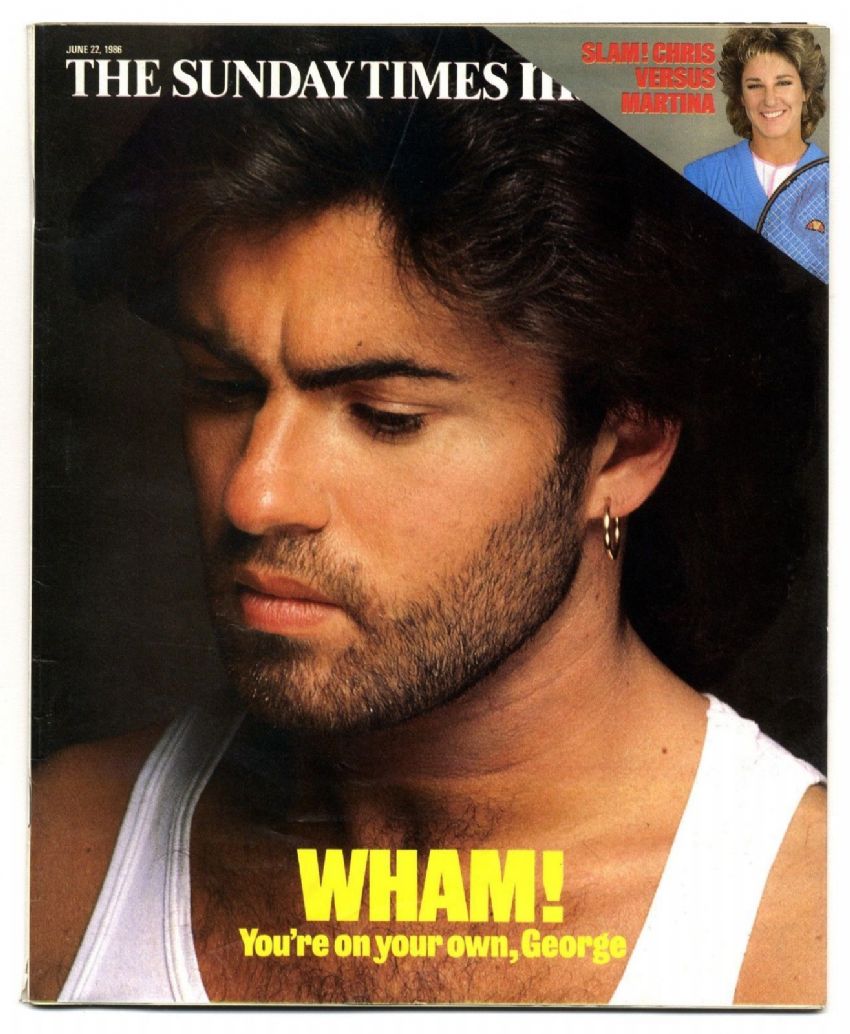
Article “Going out with a WHAM!” was written by Mick Brown and Vicki Woods and published by The Sunday Times on June 22, 1986.

Next Saturday, Wham! give their final concert. In the group’s short career, 38 million records have been sold and an endless stream of gossip and rumour (spiced with the odd fact) has appeared in the popular press. Andrew Ridgeley, so the stories go, revels in girls, booze and car crashes; George Michael apparently fails to indulge in any of them. On the day these two interviews took place, George Michael was mixing Wham!’s last record in London, while Andrew Ridgeley was at home in Monaco, eagerly awaiting the Grand Prix.
GEORGE MICHAEL
Bryan Morrison,
The anecdote embraces many elements of the George Michael myth; it speaks of the creative artist, who by his talent inherits the world, but who continues to revere only his art. It speaks of his close family ties – an essential part of the Michael myth. It suggests he does not like quails’ eggs.
There is some truth in all of that. It would be wrong to suggest that success has pained George Michael, but correct to say there are aspects to which he has adamantly refused to be accustomed.
Next weekend, Wham! will play their final concert in front of 80,000 people at Wembley Stadium. The partnership which began at school between Georgios Panayiotou, son of a Greek-Cypriot restauranteur from suburban Bushey in Hertfordshire, and his friend Andrew Ridgeley, which has been responsible for selling 22 million singles and 16 million albums around the world in the past four years, will end not with a whimper but a bang.
The end has come, says Michael, because his and Ridgeley’s “romantic idea” of what Wham! should
Wham! was George Michael’s way of achieving the perennial pop music dream of reinventing himself – an overweight, bespectacled teenager – in the image of teen-idol. He now faces the task of reinventing himself all over again in a more serious light. In fact, this has already been partly achieved. There was a moment last year, around the time of Careless Whisper, when people suddenly stopped attacking George Michael as a purveyor of lightweight, escapist froth and began talking about his burgeoning skills as a craftsman-songwriter, “the new Paul McCartney”.
Further evidence of his ability to, as it were, grow in office came two months ago when he parted company with his manager, Simon Napier-Bell, after the latter had contemplated selling his management company, and his interest in Wham!, to a company with a significant South African shareholding.
George Michael will henceforth manage himself, and nobody doubts that he will be equal to the task. Testimonies to Michael’s shrewdness and perspicacity are legion. An executive at Epic, the company which distributes and markets Wham!’s records, remembers that when Michael first arrived in its offices four years ago he made it his business to visit not only the A & R and promotion departments – the glamorous “frontline” of the music business – but also the legal, copyright and credit control departments: “He was astute enough to see how much they could help his career.”
“George picks up on things, and their importance extremely quickly,” says Napier-Bell. “He immediately understands what lawyers mean, for example, which most artists don’t. He’s very cautious with
This is indeed the case. Once we had established that I was not another Brown, from another newspaper, whom he is presently suing for libel, George Michael was charm personified, making tea and proferring chocolate fingers and Jaffa cakes.
To hear him talk of the “transaction” between himself and the press is to learn the degree to which media manipulation and massage has become one of the most useful skills he has acquired. Having exposed himself tirelessly to the tabloids in the early days of Wham!, he stopped talking to them altogether after the group’s much-publicised visit to China last year. This was because, “quite simply, I thought they had had their return for making us stars.” Since then, he has borne the indignity of being “reinvented” in successive articles. “One month I’d be fat, fascist, homosexual, with a huge Georgian house somewhere in Essex. The next I’d be a lean, virile, left-winger.”
Wham! was conceived in a spirit of optimism, fun, and the possibilities of teenagerdom; a delirious froth of shorts, singlets and Tan-fastic – a way, says Michael, of fighting “the negative reaction to youth” which prevailed at the time. The aggressive, excitable attitude to life which the group espoused was always, he says, much more a reflection of Andrew Ridgeley’s personality than his own, but Michael was excited by it as much as anyone.
“Everyone was looking at teenagers as poor bastards who were all on the dole, with nothing they could do about it. And that was rubbing off on kids themselves. Whereas I believe that when you’re 17 or 18 you have an awful lot going for you. You’re young; you have your health, and a lot of people have ambition.” As a pop star, he says, “the only way you can get optimism across is by showing yourself having a good time.”
It is a measure of the music world’s conceits that Wham!’s accentuation of the positive should have been attacked by the pop press as “capitalistic”, although Michael has spent an inordinate amount of energy attempting to convince the world that he is not a capitalist – “not in the full sense of the word”. perhaps disillusioned idealist would be a better description. During the miners’ strike, Wham! played a benefit concert for miners’ families, although on reflection he wonders whether it was really for the best, and whether “I wasn’t just encouraging a movement that a lot of very stubborn and not terribly bright left-wing groups were putting their name to.”
“Not very bright left-wing groups,” and a fruitless discussion with Paul Weller about China (which George Michael hated), were also the reason he declined an invitation to join Red Wedge – the campaign of socialist entertainers. “I didn’t want to be exploited for something I didn’t believe in. I mean, you begin by thinking that idealism is the only way to get things done. But idealism doesn’t take into account human nature a lot of the time, and when it doesn’t it’s like pissing in the wind.” Yes, he says, he does believe the world is an unfair place. And, yes, he is getting “a ridiculous amount” for what he does.
He has never worried about money, while always being conscious of the need to work for it. Even at school, he and Andrew Ridgeley were always certain that their destiny was to be pop stars. On leaving, it was Ridgeley who went on the dole, “because he didn’t want a crappy job”, Michael who worked though a series of mundane occupations to put money in his pocket.
He comes, in fact, from a family of strivers; an English mother, and Greek father, who started with nothing and worked hard to build up a prosperous restaurant business. He continued to live at home long after Wham! had become successful. Now he rents a furnished house in Kensington, “a bit like an exhibition home.” If he was decorating, he would put something “large and vague” on the walls. “I don’t like old things. I have no real regard for history, actually. I always notice, when I leave the country, the way other people appreciate English tradition, and I don’t. There’s something about the English past which I find depressing, gloomy.”
There would be no books. As a seven-year-old, under “a Seventies kind of teacher”, he read his way through the school library – “I kind of overdosed.” He has not read a book for pleasure
Success, or perhaps growing up, has tempered that ambition, he says. Now he is “perfectly prepared to see people who are better than me, as long as I think I’m the best in a particular category. There are people I’m in awe of musically; but at the same time I do believe that as an idea, an exorcism of all the things that were negative about pop music in the Seventies and Eighties, Wham! worked and were the most successful pop band of the time. That’s where I considered us to be the best.”
His abhorrence of “continuing to do things when you can no longer do them as well as you used to”, is yet another reason why Wham! are splitting up. Frank Sinatra, he thinks, should have knocked it on the head years ago. To be fair, George did not raise the subject of Sinatra; I did. But it struck a chord nonetheless. The big mistake people make, he says, is to suppose his entire career plan is now to become “Barry Manilow or something”, whereas what he wants to do is grow up “with taste”.
The greatest luxury of all which success has brought, he says, is the total freedom to now do whatever he chooses. “And you can’t ask for any luxury greater than being my age and having no one to answer to; being able to get on a plane and go anywhere – now. Just blow out this recording session, or whatever. Who wants a beautiful car if you have to drive it to work each day? My responsibilities used to be to me and Andrew – we both had a responsibility to each other. But we’re free of that now. I have more
This is all very well, but one can’t help thinking of Ridgeley. If there has been one apparently conspicuous subtext of the rise of Wham! it has been the growing gulf in the relative importance of the two members. Not quite Boswell to Johnson perhaps; more Tubbs to Crockett – or Trigger to Roy Rogers.
This, Michael gamely insists, is far from the truth. In the early days of Wham! they would be halfway through business meetings before people
Only as Michael began to develop as a songwriter, and as the evident musical leader, did the friendship show signs of strain. “But the fact is that we grew up together, and went through the whole thing together, and used each other for support. He was essential for that.”
“Most people would have resented me going forward. But it’s a real measure of his strength that his ego could take what people were throwing at him. Most people would have collapsed under that, but he didn’t.”
George Michael does not worry what will become of Andrew Ridgeley. This may be taken as a sign of confidence in his friend, rather than indifference. While Ridgeley will prang cars in his
ANDREW RIDGELEY
He said he would meet me in a hotel called the Beach Plaza. I was early, he was late. It’s rich, rich, rich, the Beach Plaza. It has a tiddly-
Andrew Ridgeley wafted into the Beach Plaza looking very much at home and very cool. He was a lovely chocolate brown
The thing about Wham!, if you care, is that while George was the sexy one on-stage, Andy was the sexy one off-stage. This might be owing to the fact that tabloid headline-writers cannot rhyme “Randy” with “George”, or it might actually be true; it’s hard to tell on a brief acquaintance.
Andrew Ridgeley is the half-of-Wham! who doesn’t. Doesn’t sing, doesn’t write music, barely plays, doesn’t arrange and doesn’t produce. Doesn’t give a bugger, neither. He looks good. George is the one who does it all in Wham!. George with the talent and the weight problem and the introspection and the voice and the beards. (Beards are what you call his sort of girl, apparently. “George has girls the way some men have beards,” I’ve been told, “to improve his appearance.”) George Michael, whom Andy calls Gorgeous or Nobby or TLTI (The Legend That Is). My son, aged nine, likes Andy best. George Michael, yeuch. Andy Ridgeley, yeeaaah. I mention my son only because his age is important. Nine. It’s a key age. It’s the age at which little boys want to be racing drivers. Andrew wants to be a Formula One driver when Wham! breaks up, and this isn’t to knock him at all. There are lots of nine-year-olds running about out there. Jocelyn Stevens, Gadaffi, Richard Branson, Jeffrey Archer. Andrew likes speed (“You only realise how fast you’re going when you’re going sideways”) and he’s made his little pile and he’s had a great time and when one door closes another door opens and off he’s gone to live slap in the middle of the Scalextric box in Monte Carlo.
Are you a millionaire?
“Oh, ho ho.”
Are you a tax exile?
“No, I’m a press exile.”
This is a slice of life for little Andrew Ridgeley from Bushey, Herts. He trips through the sparkling streets of Monte Carlo with his passes in his pocket. Passes for what? We shall see. He is wearing a cotton shirt by Yohji Yamamoto which retails at about £215; a pair of fine gabardine Italian trousers; a pair of even finer silk
A man calls out a greeting to him in French. Andrew answers in French. Better French than mine, by golly. He trips into a tall building with a spacious foyer. O, the marble halls of Monte Carlo: black marble on the floor, pink marble on the walls. The concierge asks to see his passes. This is Grand Prix week, and residents of the grand buildings which overlook the circuit have to have
Mark and Patrick’s surname is Sieff. Their father is Jonathan Sieff, who is the son of Hon Michael Sieff, who was the son of Israel Sieff, the first Lord Sieff of Marks & Spencer. Sieffs are fairly big league when it comes to silk socks, there. Mark Sieff, who is 26, “normally lives in Rome”. Patrick Sieff, who is 23, is “about to go to business school”. Both of them seem decades older than Andrew, who continues to be “interviewed” while we stand on the balcony waiting for Formula One practice to start. “I’ve got all the grub for Sunday, Mark,” Andrew says excitedly. Mark Sieff says, “Ah. Right.” Sunday was the day of the Grand Prix.
The Formula One practice began in a screaming roar of noise, like having Concorde take off in one’s kitchen. Andrew and the Sieffs leaned perilously over the balcony, Mark Sieff’s icy cool melting very slightly, and Andrew’s disappearing, never to return. Andrew began to give me the low-down on Formula One, pointing out that when he’d finished doing a bit of Formula Three he could go straight into Formula One. “My uncle was a racing driver,” he said. Really? Who was his uncle? “Peter Dunlop.” “I’m not allowed to race until after the last concert,” he yelled above the noise. Then he began helpfully giving me pointers about the cars, the drivers and the racing; many of them corrected, briskly and flatly, by the knowledgeable Mark Sieff. For example:
Ridgeley: “They can use up to four sets of tyres.”
Sieff: Actually only two are allowed.”
I expect Sieff is right. Somebody down on the circuit held a black flag out. I wanted to know what a black flag was for and turned to Andrew. “All drivers must stop,” said Mark Sieff. “I thought that was a red flag?” said Andrew. “Ah. No.” said Mark Sieff. “I tell you what,” said Andrew, “I must go to the toilet.” He was gone ages.
Formula anything is pretty pricey. I wanted to know if Andrew could afford to be a racing driver, but he said things like “Better talk to my accountant, ho ho!” Would the money stop when Wham! split up? “That’s what he’d like to know, ho ho!” How did Andrew get paid? “I have a director’s salary.” You mean, Wham! is a company? “We have 14 or 15 companies.” And they all make money? “Our operation is neither incompetent nor unprofessional.” I wondered who he was quoting. And I wondered what would happen now.
Andrew’s father is a businessman, so perhaps he can help. His mother is a teacher, teaching nine-year-olds. He has a brother who is 13 months younger than he is. “He’s a drummer. A session musician. We don’t get on very well.” He gets on with his family really, though. Except for when his mother got a bit much, just before he left home last year. She used to really wind him up, apparently. “She started treating me as if I was a pop star instead of her own son.” She seems to be under control again now. Andrew’s father was always less impressed with early Wham!. “He’d never really taken in how big we were,” Andrew said, “until he came along to Capital Radio one day when we were doing a lip-synch. He was stunned to see 20,000 little girls running around.”
Andrew is neat and clean and
I’d been dying to see his flat. You never do see rock stars’ flats somehow, not unless you’re Paula Yates and photographed the star in his underpants. Andrew is a pop star anyway. Not a rock star. He shuddered at the thought. Ergh, all those
The flat is halfway up a low-rise building, facing the sea. The entire inside surfaces – walls, ceilings
Suddenly he said, “I want to show you my new curtains. They’re beautiful. They go up and down.” And he skipped off into the bedroom. Reader, I followed him, nearly tripping over a pair of slender black high-heels that belonged to Donya Fiorentino, Andrew’s current 18-year-old American girlfriend. “‘Scuse the unmade bed,” said Andrew, tugging at a string on the wall, while I averted my eyes from the rumpled duvet, and focused them on the festoon blind. It was the festoon blind that should have gone up, and down (but didn’t). It was a very pretty festoon blind, and Andrew’s bursting pride in it was very pretty too.
I asked him about his girlfriend. He said that she was very beautiful, and that she was “a bigoted feminist” and that she’d spent all morning asking him what he was going to say about her.
I asked him why he hadn’t sung on Feed the World. He said he hadn’t got up in time.
I asked him how much he weighed and he said 62

Wham! Andrew and George will always be beautiful together
Wham! Andrew and George will always be beautiful together.