

George Michael’s induction into the Rock & Roll Hall of Fame Class of 2023 celebrates a career that transformed pop music and inspired generations of artists. This essay, featured in the official Rock Hall 2023 Induction Program, explores Michael’s extraordinary journey—from his rise as a pop sensation with Wham! to his evolution as a boundary-pushing solo artist. His soulful voice, artistic integrity, and cultural impact solidify his place among music’s greatest legends, making his induction a fitting tribute to his enduring legacy.
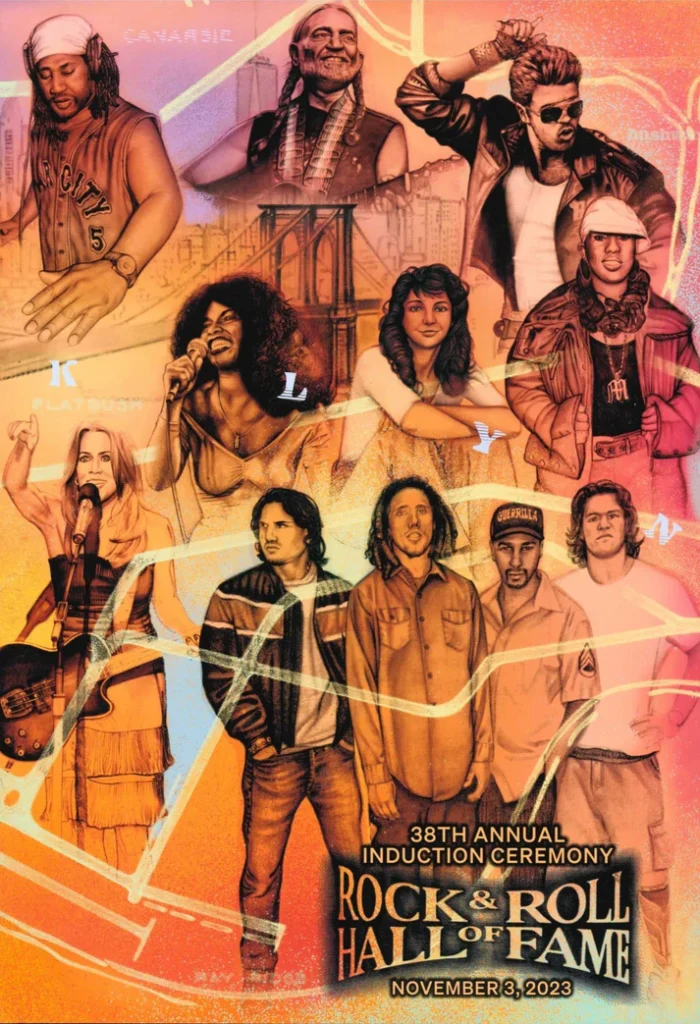
George Michael: His Path From Wham! Pop Star To Serious Solo Artist Paved The Way For Many Of Those Who’ve Followed.
By Annie Zaleski
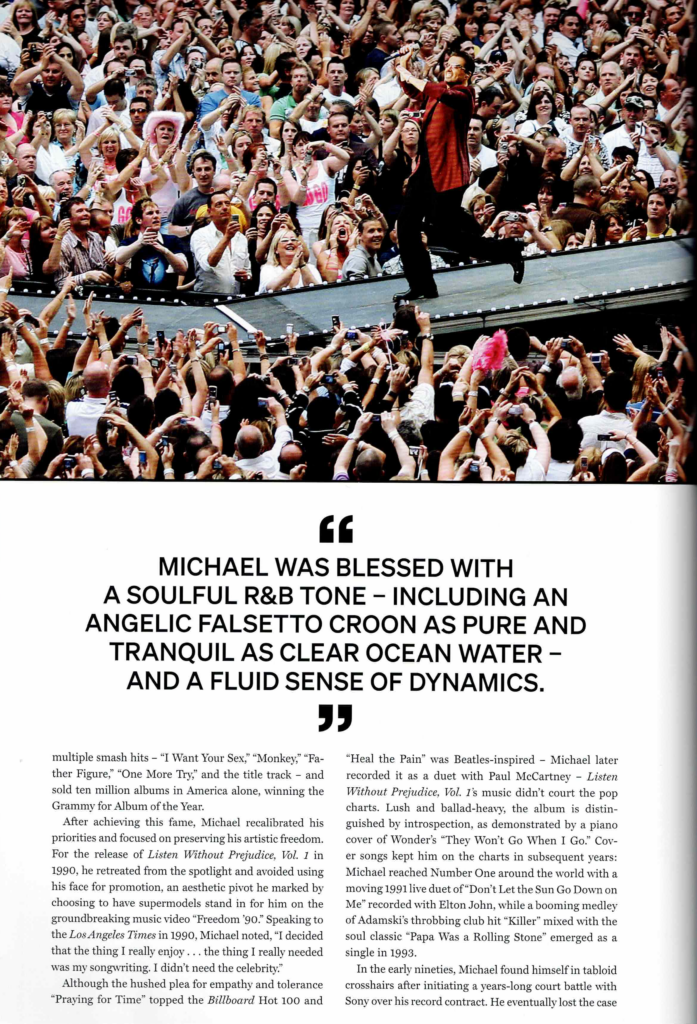
In April 1992, George Michael performed several songs with Queen at the Freddie Mercury Tribute Concert for AIDS Awareness, a sold-out event that drew 72,000 people to Wembley Stadium. Michael was no stranger to the massive venue: Six years before, his eighties pop group Wham! had performed their emotional final concert at the same place. This time, however, Michael was honoring Mercury by commanding the stage with the yearning rocker “Somebody to Love.” Rehearsal footage of his performance is stunning. Michael sings full-tilt like he’s already in front of the Wembley crowd: nailing every syllable with graceful aplomb; landing the soaring high notes without breaking a sweat; and air-drumming along with every punchy beat from Queen’s Roger Taylor. Anticipation builds as Michael nears the song’s denouement — an aching, sustained high note that comes within the line, “Can anybody find me somebody to love?” He sounds effortless here too, immersed in the songs anguished plea, before finishing the tune with additional urgent wails. At the end, Michael receives a rousing round of applause from fellow participants David Bowie and Seal, among others in attendance.
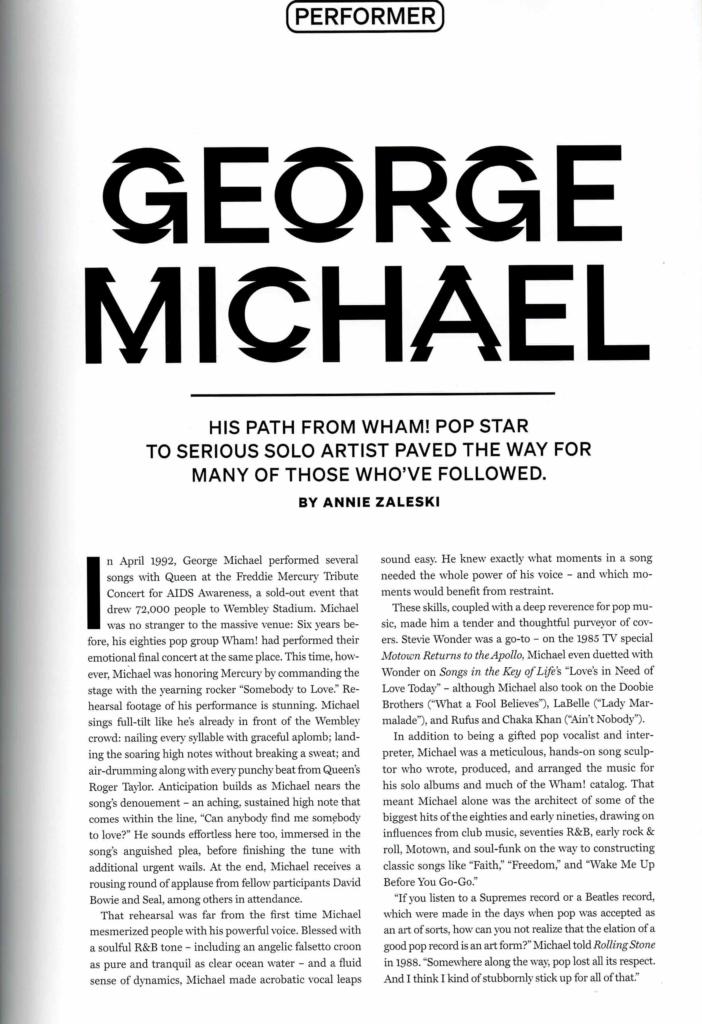
That rehearsal was far from the first time Michael mesmerized people with his powerful voice. Blessed with a soulful R&B tone – including an angelic falsetto croon as pure and tranquil as clear ocean water – and a fluid sense of dynamics, Michael made acrobatic vocal leaps sound easy. He knew exactly what moments in a song needed the whole power of his voice — and which moments would benefit from restraint.
These skills, coupled with a deep reverence for pop music, made him a tender and thoughtful purveyor of covers. Stevie Wonder was a go-to — on the 1985 TV special Motown Returns to the Apollo, Michael even duetted with Wonder on Songs in the Key of Life’s “Love’s in Need of Love Today” – although Michael also took on the Doobie Brothers (“What a Fool Believes”), LaBelle (“Lady Marmalade”), and Rufus and Chaka Khan (“Ain’t Nobody”).
In addition to being a gifted pop vocalist and interpreter, Michael was a meticulous, hands-on song sculptor who wrote, produced, and arranged the music for his solo albums and much of the Wham! catalog. That meant Michael alone was the architect of some of the biggest hits of the eighties and early nineties, drawing on influences from club music, seventies R&B, early rock & roll, Motown, and soul-funk on the way to constructing classic songs like “Faith,” “Freedom,” and “Wake Me Up Before You Go-Go.”
“If you listen to a Supremes record or a Beatles record, which were made in the days when pop was accepted as an art of sorts, how can you not realize that the elation of a good pop record is an art form?” Michael told Rolling Stone in 1988. “Somewhere along the way, pop lost all its respect. And I think I kind of stubbornly stick up for all of that”
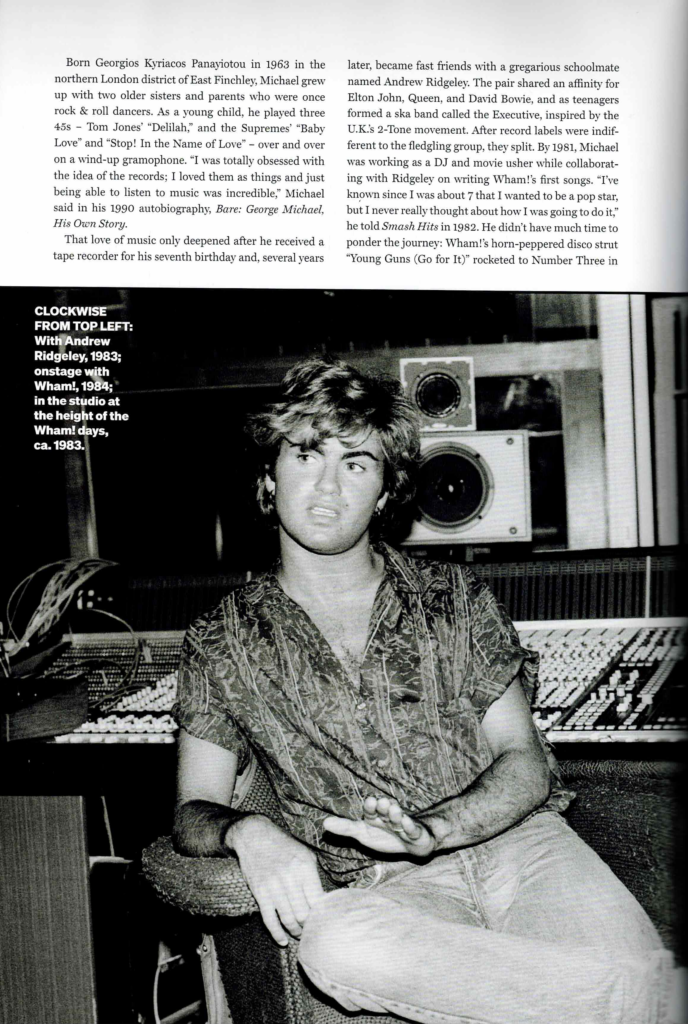
Born Georgios Kyriacos Panayiotou in 1963 in the northern London district of East Finchley, Michael grew up with two older sisters and parents who were once rock & roll dancers. As a young child, he played three 45s — Tom Jones’ “Delilah,” and the Supremes’ “Baby Love” and “Stop! In the Name of Love” – over and over on a wind-up gramophone. “I was totally obsessed with the idea of the records; I loved them as things and just being able to listen to music was incredible,” Michael said in his 1990 autobiography, Bare: George Michael, His Own Story.
That love of music only deepened after he received a tape recorder for his seventh birthday and, several years later, became fast friends with a gregarious schoolmate named Andrew Ridgeley. The pair shared an affinity for Elton John, Queen, and David Bowie, and as teenagers formed a ska band called the Executive, inspired by the U.K’s 2-Tone movement. After record labels were indifferent to the fledgling group, they split. By 1981, Michael was working as a DJ and movie usher while collaborating with Ridgeley on writing Wham!’s first songs. “I’ve known since I was about 7 that I wanted to be a pop star, but I never really thought about how I was going to do it,” he told Smash Hits in 1982. He didn’t have much time to ponder the journey: Wham!’s horn-peppered disco strut “Young Guns (Go for It)” rocketed to Number Three in the U.K. later that year. Buoyed by kicky singles such as “I’m Your Man” and “Wake Me Up Before You Go-Go,’ Wham! soon found even greater global fame, helming a modern Motown revival in the U.K.
As Wham!’s star rose, Michael maintained his creative integrity; notably, he once cast aside a version of “Careless Whisper” cut with legendary producer Jerry Wexler at Muscle Shoals Sound Studio because the finished version didn’t quite meet his exacting standards. Later in Wham!’s career, he even played every instrument on the glimmering “Last Christmas,” a modern holiday standard that’s simultaneously wistful, melancholy, and hopeful. As the latter song implies, Michael’s approach to pop music was already both serious – Wham!’s sassy 1982 debut single, “Wham Rap! (Enjoy What You Do?),” was deceptively escapist, written in response to the pair’s time on the unemployment line – and sophisticated. The mournful saxophone quavering through “Careless Whisper” exudes rusted glamour, as Michael confesses shame and guilt over the way he treated a friend, while “Everything She Wants” cloaks lyrics about a tortured relationship in velvet-touch funk-pop.

By the time Wham! split in 1986, Michael had started to transition into a solo career. The following year, he landed a Number One single in the U.S. and U.K. (and nabbed a Grammy Award for Best R&B Performance by a Duo or Group With Vocal) for “I Knew You Were Waiting (for Me),” a spirited and joyful duet with Aretha Franklin.
This set the stage for the fall 1987 release of Faith, an era-defining (but genre-defying) album that embraced torchy jazz, gospel-tinged balladry, bluesy rock, and seductive funk. Eschewing the surfer-heartthrob bleach-blond hair look that made him a constant presence on MTV with Wham!, Michael embraced a tougher image, donning a leather jacket and a five o’clock shadow. Yet his lyrics were vulnerable — Fuith’s characters proudly held out for a love they deserve, unabashedly expressed desire, and maintained conflicting feelings for an ex-partner. A worldwide commercial success, the full-length produced multiple smash hits – “I Want Your Sex,” “Monkey,” “Father Figure,” “One More Try,” and the title track — and sold ten million albums in America alone, winning the Grammy for Album of the Year.
MICHAEL WAS BLESSED WITH A SOULFUL R&B TONE – INCLUDING AN ANGELIC FALSETTO CROON AS PURE AND TRANQUIL AS CLEAR OCEAN WATER – AND A FLUID SENSE OF DYNAMICS.
After achieving this fame, Michael recalibrated his priorities and focused on preserving his artistic freedom. For the release of Listen Without Prejudice, Vol. 1 in 1990, he retreated from the spotlight and avoided using his face for promotion, an aesthetic pivot he marked by choosing to have supermodels stand in for him on the groundbreaking music video “Freedom ’90.” Speaking to the Los Angeles Times in 1990, Michael noted, “I decided that the thing I really enjoy. . . the thing I really needed was my songwriting. I didn’t need the celebrity.”
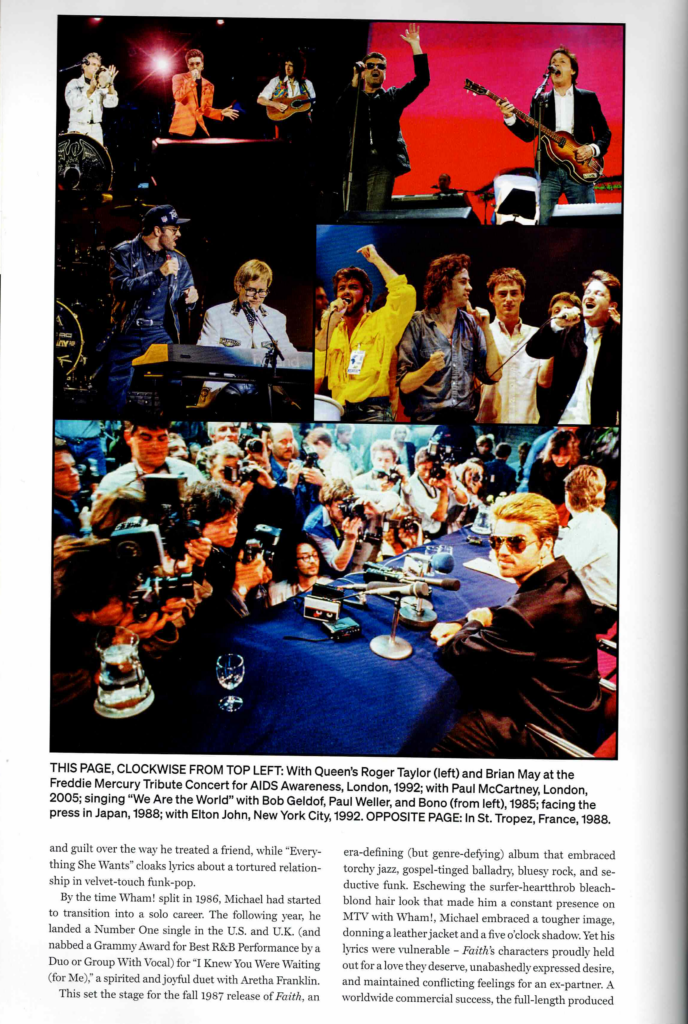
Although the hushed plea for empathy and tolerance “Praying for Time” topped the Billboard Hot 100 and “Heal the Pain” was Beatles-inspired – Michael later recorded it as a duet with Paul McCartney – Listen Without Prejudice, Vol. I’s music didn’t court the pop charts. Lush and ballad-heavy, the album is distinguished by introspection, as demonstrated by a piano cover of Wonders “They Won’t Go When I Go.” Cover songs kept him on the charts in subsequent years: Michael reached Number One around the world with a moving 1991 live duet of “Don’t Let the Sun Go Down on Me” recorded with Elton John, while a booming medley of Adamski’s throbbing club hit “Killer” mixed with the soul classic “Papa Was a Rolling Stone” emerged as a single in 1993.
In the early nineties, Michael found himself in tabloid crosshairs after initiating a years-long court battle with Sony over his record contract. He eventually lost the case and several years of his career) before returning in 1996 with the mature, meditative Older, which dabbled in simmering electronica (“Fastlove”) and sleek torch songs such as the title track. Poignantly, Michael also dedicated Older to his first love, Anselmo Feleppa — who died of a brain hemorrhage in 1993 while receiving treatment for AIDS – and wrote the achingly gorgeous elegy “Jesus to a Child” for him: “So the words you could not say/I’ll sing them for you.”
In 1998, Michael received unwanted press attention again after being arrested in Los Angeles for what police described as a “lewd act” in a public restroom. The arrest prompted him to come out publicly as gay in a CNN interview. “At the end of the day, all I can be is honest,” he told The Advocate in 1999. “I’ve reached a very good point of self-acceptance. I don’t have any shame about my sexuality. I don’t think people are going to desert me because they know more about me.”
Michael indeed continued touring and recording, releasing a covers album (Songs From the Last Century in 1999) and a final collection of originals, Patience, in 2004, marked by the Human League-sampling political critique “Shoot the Dog.” Throughout the 2000s, he remained committed to philanthropy – for example, doing a 2006 benefit show for NHS nurses to thank them for caring for his late mother, and secretly donating generously to HIV/AIDS charities – and was a vocal supporter of LGBTQ rights.
In 2016, Michael enlisted Nile Rodgers for an update of a B-side called “Fantasy” for a forthcoming reissue, Listen Without Prejudice/MTV Unplugged. Tragically, on Christmas Day of that year, Michael, who had been suffering from a heart condition, died at home. He was 53.
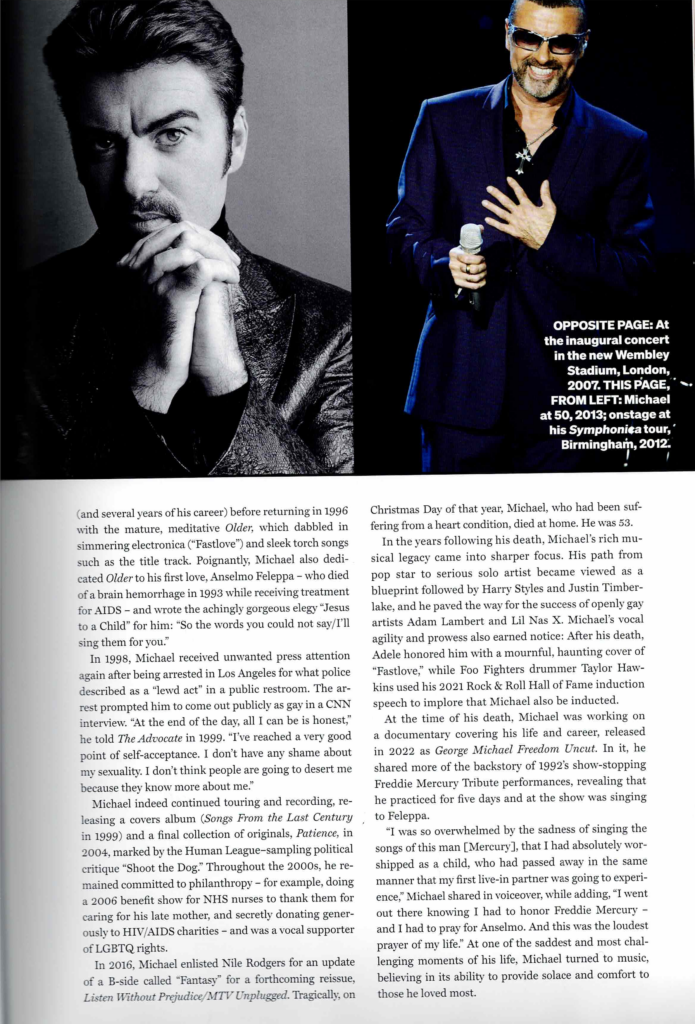
In the years following his death, Michael’s rich musical legacy came into sharper focus. His path from pop star to serious solo artist became viewed as a blueprint followed by Harry Styles and Justin Timberlake, and he paved the way for the success of openly gay artists Adam Lambert and Lil Nas X. Michael’s vocal agility and prowess also earned notice: After his death, Adele honored him with a mournful, haunting cover of “Fastlove,” while Foo Fighters drummer Taylor Hawkins used his 2021 Rock & Roll Hall of Fame induction speech to implore that Michael also be inducted.
At the time of his death, Michael was working on a documentary covering his life and career, released in 2022 as George Michael Freedom Uncut. In it, he shared more of the backstory of 1992’s show-stopping Freddie Mercury Tribute performances, revealing that he practiced for five days and at the show was singing to Feleppa.
“I was so overwhelmed by the sadness of singing the songs of this man [Mercury], that I had absolutely worshipped as a child, who had passed away in the same manner that my first live-in partner was going to experience,” Michael shared in voiceover, while adding, “I went out there knowing I had to honor Freddie Mercury – and I had to pray for Anselmo. And this was the loudest prayer of my life.” At one of the saddest and most challenging moments of his life, Michael turned to music, believing in its ability to provide solace and comfort to those he loved most.
Read the PDF version of this article:
George_Michael_Induction_Essay