

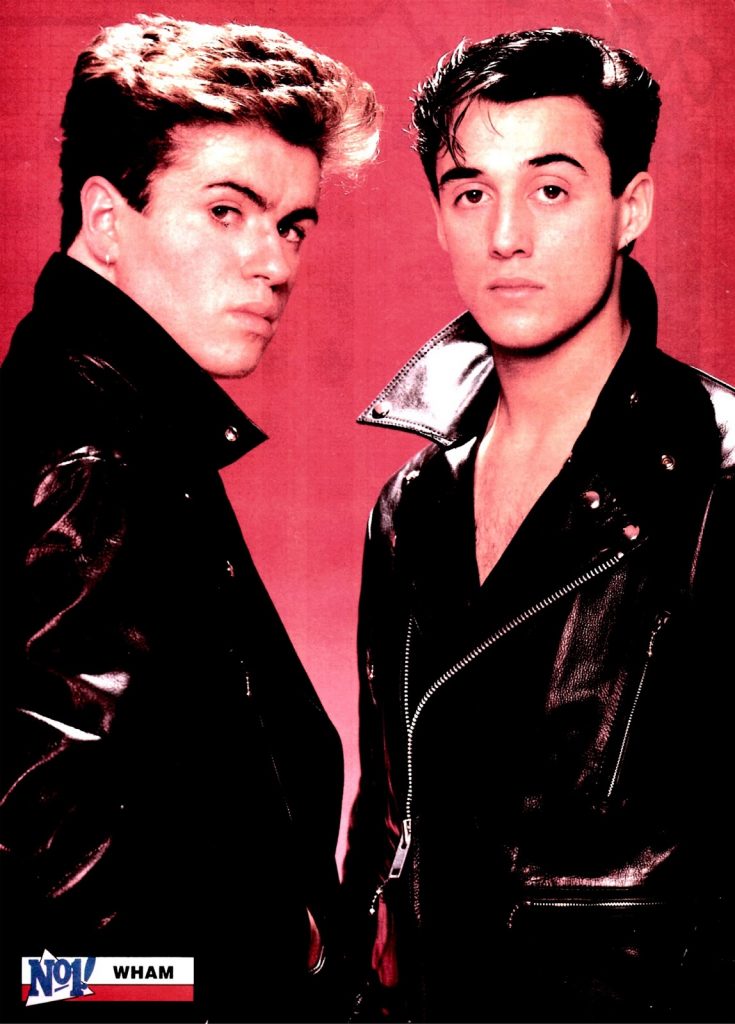
Story of how Wham!’s George Michael and Andrew Ridgeley very first contract with record company Innervision was unfair and oppressive.
No self-respecting pop star’s This Is Your Life would be complete without a few stories about the financial hardships they endured before they started making hit records. Wham!’s story is interesting because George and Andrew were still having to survive on £40 a week after they’d had several hit singles and a hit album. Wham!’s experiences (as related by Simon Garfield in his rather brilliant book about the music business, Expensive Habits) illustrate what can happen when a young group, hungry for success signs a contract in a cafe (true!) without reading the small print …
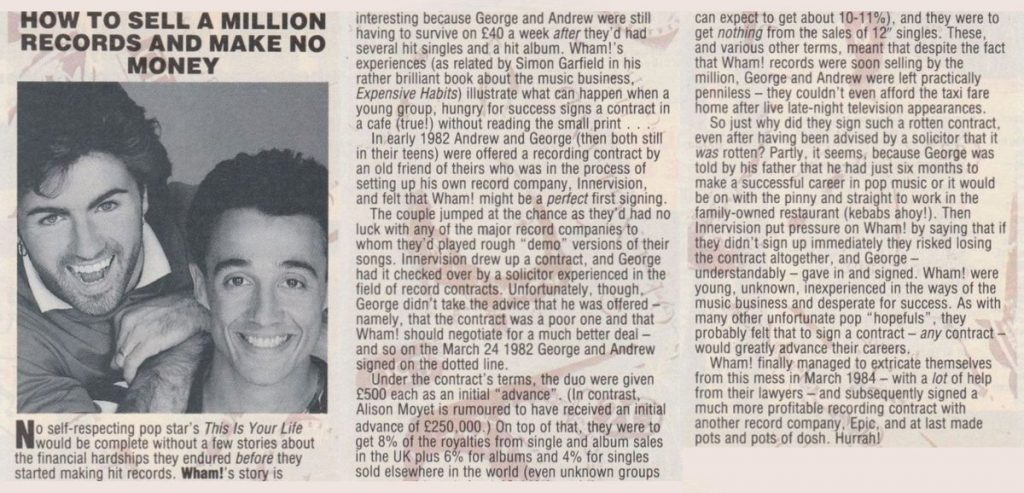
In early 1982 Andrew and George (then both still in their teens) were offered a recording contract by an old friend of theirs who was in the process of settling up his own record company, Innervision, and felt that Wham! might be a perfect first signing.
The couple jumped at the chance as they’d had no luck with any of the major record companies to whom they’d played rough “demo” versions of their songs. Innervision drew up a contract, and George had it checked over by a solicitor experienced in the field of record contracts. Unfortunately, though, George didn’t take the advice that he was offered — namely, that the contract was a poor one and that Wham! should negotiate for a much better deal — and so on the March 24, 1982 George and Andrew signed on the dotted line.
Under the contract’s terms, the duo were given £500 each as an initial “advance.” (In contrast, Alison Moyet is rumoured to have received an initial advance of £250,000). On top of that, they were to get 8% of the royalties from single and album sales in the UK plus 6% for albums and 4% for singles sold elsewhere in the world (even unknown groups can expect to get about 10-11%), and they were to get nothing from the sales of 12″ singles. These, and various other items, meant that despite the fact that Wham! records were soon selling by the million, George and Andrew were left practically penniless — they couldn’t even afford the taxi fare home after live late-night television appearances.
So just why did they sign such a rotten contract, even after having been adviced by a solicitor that it was rotten? Partly, it seems, because George was told by his father that he had just six months to make a successful career in pop music or it would be on with the pinny and straight to work in the family-owned restaurant (kebabs ahoy!). Then Innervision put pressure on Wham! by sating that if they didn’t sign up immediately they risked losing the contract altogether, and George — understandably — gave in and signed. Wham! were young, unknown, inexperienced in the ways of the music business and desperate for success. As with many other unfortunate pop “hopefuls,” they probably felt that to sign a contract — any contract — would greatly advance their careers.
Wham! finally managed to extricate themselves from this mess in March 1984 — with a lot of help from their lawyers — and subsequently signed a much more profitable recording contract with another record company, Epic, and at last made pots and pots of dough. Hurrah!
